Flintshire · Wales
Pedestrian protection bollards in Mold
Planning pedestrian protection bollards in Mold? We check ownership, consents and buried services first, then quote a fixed price.
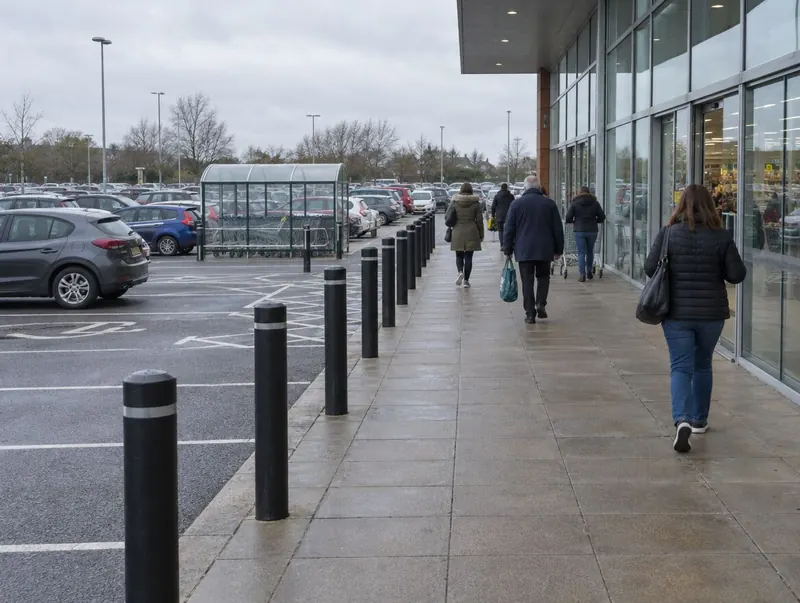 Computer-generated image
Pedestrian protection in Mold
From filling-station forecourts, community car parks and high street shopfronts, Mold has plenty of places where pedestrian protection bollards earn their keep. Products range from unrated steel posts to bollards tested against low-speed impacts under PAS 170-1.
Coverage in Mold takes in the CH7 postcode district and nearby places like Mynydd Isa, Northop Hall, Drury and Treuddyn. We also cover neighbouring Deeside (4.9 miles), Flint (5.4 miles), Coedpoeth (8.5 miles) and Wrexham (10.4 miles) — distances are straight-line.
Local details
- Area
- Flintshire, Wales
- Highway authority
- Flintshire County Council (local roads)
- Planning authority
- Flintshire County Council
- Postcodes
- CH7
- Guide price
- Typically £235–£1,145 per bollard + VAT; minimum job £575
- Survey
- Free, with a fixed written quote
Typical pedestrian protection bollards jobs in Mold
Around Mold, pedestrian protection bollards usually solve one of these:
- EV charging points and trolley shelters
- Walkways through supermarket and retail park car parks
- Outdoor seating at cafes, pubs and restaurants
Guide prices for Mold
| Specification | Guide price | Includes |
|---|---|---|
| Standard | £235–£625 + VAT | Standard post, foundation, reinstatement |
| Upgraded | £515–£905 + VAT | Upgraded finish or fittings, reflective band, matched keys |
| Premium | £795–£1,145 + VAT | Heavy-duty or architectural spec, premium finish |
Per bollard, supplied and installed; -3% for Wales. Guide only — the fixed price follows a survey.
Consents, ground and services in Mold
Local roads and pavements in Mold are the responsibility of Flintshire County Council as highway authority, with the Welsh Government's trunk road agents handling trunk roads. Posts on the public highway need that authority's consent; private land does not.
If your site in Mold is listed or inside a conservation area, check with the local planning authority (Flintshire County Council) before choosing a finish — heritage settings often favour cast iron or painted steel over stainless.
Raised kerbs also change the picture: a high kerb slows a wheel but does not stop a bumper, so the post still needs to sit within reach of the overhang rather than behind it. Reinstatement keeps walkways level and flush, because a trip edge around a new post in a busy car park creates the very hazard the posts are meant to reduce.
- Use contrasting bands so posts are visible to partially sighted people, and avoid linking chains across routes.
- Record why posts are where they are in the site's risk assessment, especially at drive-thrus and seating areas.
Installation, step by step
Set out the line
Posts are set out allowing for bumper overhang and keeping clear routes for pedestrians, trolleys and wheelchairs.
Reinstate
Paving, tarmac or concrete is made good flush around each post, with tactile paving reinstated where it was disturbed.
Agree a plan for live trading
Work is phased so entrances and walkways stay open, with each section fenced while it is dug and set. Busy sites often prefer early starts or quieter weekdays.
Specification choices
| Option | Detail |
|---|---|
| Wheel stops and kerbs | Used with bollards to stop cars before they reach the posts, reducing daily knocks. |
| Visibility bands | Reflective and contrasting bands help drivers and partially sighted pedestrians see posts. |
| Stainless or architectural finishes | Stainless sleeves or decorative posts for shop entrances and public-facing frontages. |
What affects the quote
Two Mold jobs with the same number of posts can price quite differently. The usual reasons:
- Reinstatement of tactile paving and walkway surfaces
- Finishes such as stainless or decorative posts
- Number of posts and length of line
Looking after them
Damaged posts near entrances should be dealt with quickly, as a bent post with a torn edge is a hazard in its own right. Keep a simple note of strikes and their locations; over a year it shows which parts of the car park drivers find awkward, which is useful when the site is next resurfaced or re-lined.
For damaged or loose posts in Mold, repairs and replacements are priced in writing first.
Questions about pedestrian protection bollards in Mold
Which parts of Mold do you cover for pedestrian protection bollards?
We cover all of Mold (CH7) and the rest of Flintshire. We also work in Deeside, Flint and Coedpoeth.
Do I need consent for pedestrian protection bollards on a public footway in Mold?
Before digging near the kerb in Mold we establish who owns the ground: adopted footways are Flintshire County Council's responsibility, trunk roads the Welsh Government's, and everything else belongs to the site owner.
What's a typical price for pedestrian protection bollards in Mold?
In Mold, typically £235–£1,145 per bollard, supplied and installed, plus VAT, with a minimum job of £575 plus VAT, using our Wales guide prices. The fixed figure comes in writing after we've seen the site.
Do pedestrian protection bollards need to be crash-rated?
Not usually. They deal with low-speed driver errors, so firmly founded steel posts often suffice. Where an owner, insurer or designer wants proven performance, PAS 170-1 tested products are the usual choice.
Should bollards be added at a drive-thru order point?
Often, yes, where people queue or sit beside the lane. Posts should follow the curve of the lane and be closest together at corners, where drivers tend to misjudge the turn. The positions are agreed on site with the operator.