West Dunbartonshire · Scotland
Bollard repairs in Clydebank
Local bollard repairs across Clydebank — we diagnose, explain and price in writing before doing more.
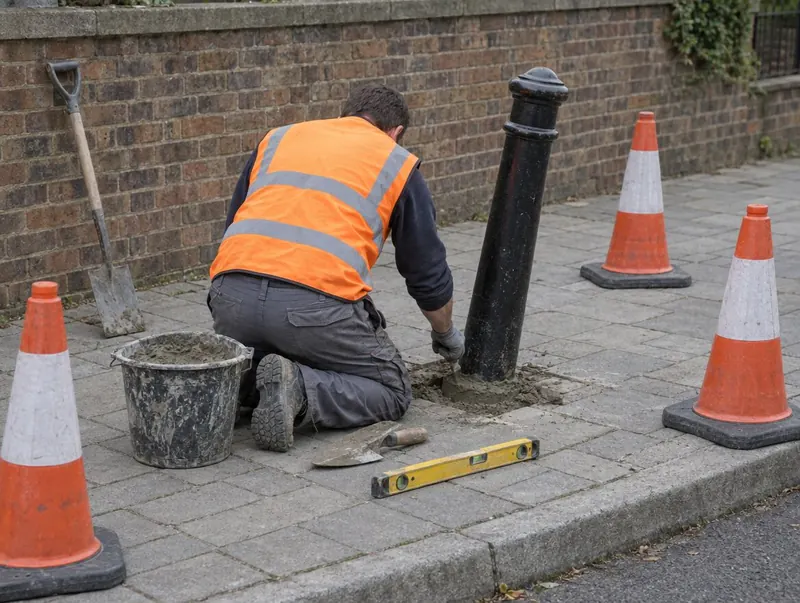 Computer-generated image
About bollard repairs in Clydebank
We carry out bollard repairs throughout Clydebank, typically for local parades, high street shopfronts and community buildings. Typical repairs include re-bedding a loose or leaning post, re-fixing a base plate with new anchors, replacing a seized socket, lock, cap or hinge, clearing a blocked cassette and renewing reflective bands.
We cover Clydebank's G81 and G60 postcode districts, including places such as Bowling. Jobs in Clydebank can be combined with work in Erskine (1.7 miles), Renfrew (2.1 miles), Bearsden (3 miles) and Milngavie (4.2 miles) (straight-line distances). Glasgow is around 6 miles away.
Key facts for this area
- Area
- West Dunbartonshire, Scotland
- Roads authority
- West Dunbartonshire Council (local roads)
- Planning authority
- West Dunbartonshire Council
- Postcodes
- G81 and G60
- Guide price
- Typically £115–£445 per visit + VAT (£135–£525 inc VAT for homes)
- Survey
- Paid visit, price confirmed in writing first
Guide prices for Clydebank
| Specification | Guide price | Includes |
|---|---|---|
| Standard | £115–£255 + VAT · £135–£305 inc VAT | Straighten or re-bed one post |
| Upgraded | £215–£355 + VAT · £255–£425 inc VAT | Several posts, or new socket, lock or band |
| Premium | £315–£445 + VAT · £375–£525 inc VAT | Larger repair with new foundation |
Per visit, typically one to three posts; no regional adjustment. Guide only — the visit price is confirmed in writing first.
Typical bollard repairs requests in Clydebank
Typical reasons for bollard repairs in Clydebank:
- Missing caps, worn paint and faded reflective bands
- Posts leaning or rocking after a vehicle knock
- Fold-down posts with bent hinges or broken locks
What we check first in Clydebank
Clydebank falls under West Dunbartonshire Council as roads authority. If the line of posts crosses onto adopted road or pavement, permission comes before excavation; on private land it does not.
Many private-land installations in Clydebank need no planning application, but the rules don't clearly cover bollards, so listed buildings, conservation areas and prominent frontages are worth raising with the planning team at West Dunbartonshire Council before posts go in.
Sockets and cassettes are reset to the exact finished surface level, with drainage restored beneath. Reinstatement matches what is there, whether tarmac, block paving, flags, resin or turf, though older or weathered surfaces may show a visible patch.
- Do not repair crash-rated bollards in ways that change the tested product; involve the manufacturer.
- Make damaged posts safe promptly, as a leaning post or open socket on a footway is a trip hazard.
Installation, step by step
Receive a written price
We confirm the cost of the visit and the expected work in writing before anyone attends. Nothing is done until you have agreed it.
Make safe if needed
Where a post is a hazard now, the first step can be to make it safe by removing or capping it, priced separately in writing so you can approve it on its own.
Record and hand back
The repaired posts are checked, the surface is made good and photographs are sent so you have a record for your maintenance file.
Options to consider
| Option | Detail |
|---|---|
| Coatings | Touch-up or full repainting of steel and cast iron posts to stop corrosion taking hold. |
| New sockets | Replacing seized, crushed or loose sockets for removable bollards, set flush with a working lid. |
| Re-fixing base plates | New resin anchors in fresh positions, a larger plate to spread the load, or a slab repair before re-fixing. |
What affects the quote
Our Scotland guide prices are a starting point; the survey in Clydebank firms them up. What tends to move them:
- Access, traffic management and working hours
- Making safe before the main repair
- Availability of matching parts, locks and caps
Looking after them
Keep a record of bollard types, suppliers, key numbers and colours on site, so a repair can be quoted and matched quickly when it is needed. Most repair call-outs come from small problems left too long.
If posts in Clydebank are later hit or damaged, we can repair or replace them — see bollard repairs.
Common questions
Do you carry out bollard repairs in Clydebank?
We cover all of Clydebank (G81 and G60) and the rest of West Dunbartonshire. We also work in Erskine, Renfrew and Bearsden.
Who gives permission for bollards on the pavement in Clydebank?
For anything on the public footway in Clydebank we check with the roads authority first — West Dunbartonshire Council for local roads, Transport Scotland on trunk routes. Private ground such as a car park or forecourt only needs the owner's go-ahead.
What's a typical price for bollard repairs in Clydebank?
In Clydebank, typically £115–£445 per visit, typically one to three posts, plus VAT (£135–£525 including VAT for homeowners), using our Scotland guide prices. We confirm the visit price in writing before attending.
Why does our base-plated bollard keep working loose?
Usually because the anchors are in weak, cracked or thin concrete, or too close to an edge or joint. Re-tightening does not last. New anchors in fresh positions, a larger plate or a slab repair is the lasting fix.
Can a bent bollard be straightened?
Only if the bend is slight and the steel has not creased or torn. A sharply bent post is weakened and should be replaced. Often the post is fine and it is the foundation that has moved, which re-bedding fixes.