Kent · England
Bollard replacement in Deal
Planning replacement bollards in Deal? We check ownership, consents and buried services first, then quote a fixed price.
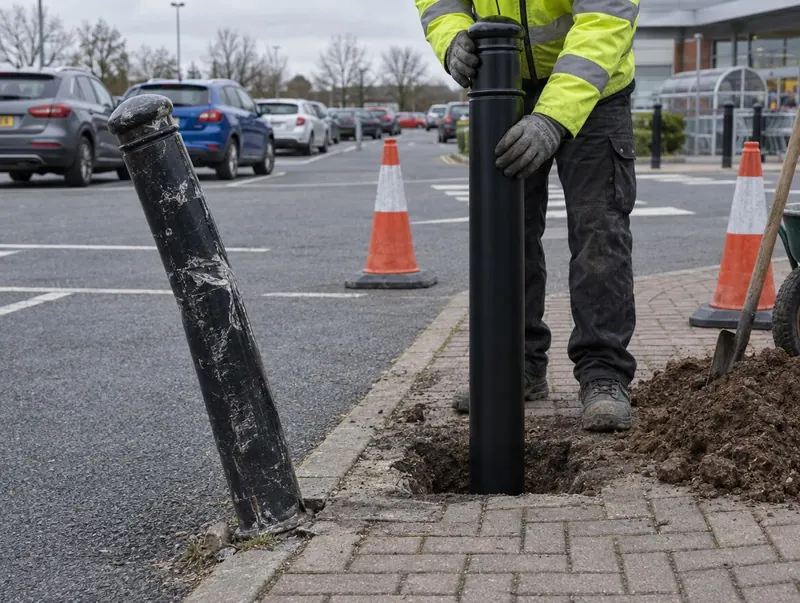 Computer-generated image
Bollard replacement in Deal
Replacement bollards suit plenty of Deal sites, high street shopfronts, residential driveways and schools among them. Replacement is the right answer when a post is too damaged to repair or no longer suits how the site is used.
We work across CT14 and CT13 — Deal itself and places including Sholden, Ringwould, Tilmanstone and Ripple. Nearby, we also work in Dover (7.8 miles), Ramsgate (7.8 miles), Broadstairs (9.5 miles) and Margate (11 miles), measured as the crow flies.
Local details
- Area
- Kent, England
- Highway authority
- Kent County Council (local roads)
- Planning authority
- the council for Dover
- Postcodes
- CT14 and CT13
- Guide price
- Typically £225–£1,245 per post + VAT (£265–£1,495 inc VAT for homes); minimum job £465
- Survey
- Free, with a fixed written quote
- Nearby
- Dover (7.8 mi), Ramsgate (7.8 mi), Broadstairs (9.5 mi), Margate (11 mi)
Typical replacement bollards requests in Deal
What replacement bollards usually sort out in Deal:
- Single missing posts in an otherwise sound line
- Upgrading posts that keep being hit
- Corroded steel posts at the end of their life
Guide prices for Deal
| Specification | Guide price | Includes |
|---|---|---|
| Standard | £225–£665 + VAT · £265–£795 inc VAT | Standard post, foundation, reinstatement |
| Upgraded | £535–£975 + VAT · £635–£1,145 inc VAT | Upgraded finish or fittings, reflective band, matched keys |
| Premium | £855–£1,245 + VAT · £1,045–£1,495 inc VAT | Heavy-duty or architectural spec, premium finish |
Per post replaced, old post and footing removed; +6% for South East. Guide only — the fixed price follows a survey.
What we check first in Deal
In Deal, work on adopted pavements and verges needs consent from Kent County Council, the local highway authority. Car parks, forecourts and other private land only need the owner's permission.
Bollards on private land often don't need planning permission, but it depends on the council's view, the height and the location; in a conservation area, next to a listed building or under an Article 4 direction, ask the local planning authority (the council for Dover) first — we flag this at survey.
If the old foundation is cracked from the impact, it is removed entirely; if it is sound and suits the new post, reuse can reduce disruption. Reinstatement matches the surrounding surface, though weathered paving and older tarmac may leave a visible patch.
- On public highway, the highway authority may need to approve the replacement or carry out the work itself.
- Where bollards were required by a planning condition, a security plan or a lease, check that any change of type still meets that requirement.
What happens on site
Make safe
If a broken post or stub is a hazard, it can be removed or capped first. That is priced separately in writing so you can approve it on its own.
Order the replacement
Matching posts, sockets or castings are ordered, and you see details of any close equivalent before it is confirmed.
Install the new post
The new bollard is set in a fresh foundation, aligned with its neighbours and the surface is reinstated to match.
Finishes and options
| Option | Detail |
|---|---|
| Change of type | Swapping fixed posts for removable, telescopic, flexible or polymer bollards to suit how the site is used. |
| Making safe | Removing or capping a dangerous broken stub before the replacement is fitted. |
| Matched finishes | RAL powder coat, stainless grade and finish, or heritage paint schemes matched to the existing line. |
What moves the price in Deal
Our South East guide prices are a starting point; the survey in Deal firms them up. What tends to move them:
- Size and condition of the old foundation
- Number of posts and the product chosen
- Making safe before the replacement
Looking after them
Keep a record of the new product, finish and supplier so future replacements match. Treat new posts as part of your routine inspections: check for lean, chips and faded bands.
If posts in Deal are later hit or damaged, we can repair or replace them — see bollard repairs.
Common questions
Which parts of Deal do you cover for replacement bollards?
We cover all of Deal (CT14 and CT13) and the rest of Kent. We also work in Dover, Ramsgate and Broadstairs.
Who gives permission for bollards on the pavement in Deal?
In Deal, work on adopted pavements and verges needs consent from Kent County Council, the local highway authority. Car parks, forecourts and other private land only need the owner's permission.
How much do replacement bollards cost in Deal?
In Deal, typically £225–£1,245 per post replaced, old post and footing removed, plus VAT (£265–£1,495 including VAT for homeowners), with a minimum job of £465 plus VAT, using our South East guide prices. The fixed figure comes in writing after we've seen the site.
What happens to the old bollard?
It is taken away with the broken-out concrete. Steel and iron are recycled where possible. Original heritage bollards can be returned to you if you want to keep them.
Can you replace just one bollard in a line?
Yes. We measure and match the existing posts so the new one sits in line at the same height and finish. If the original product is no longer made, we show you a close equivalent first.
Bollard replacement in nearby towns
- Dover (7.8 mi)
- Ramsgate (7.8 mi)
- Broadstairs (9.5 mi)
- Margate (11 mi)
- Folkestone (14.1 mi)
- Canterbury (14.5 mi)