Devon · England
Crash-rated bollard installation in Exmouth
Local installation of crash-rated bollards in Exmouth — free survey, fixed written price, and posts set to the right spacing for people and vehicles.
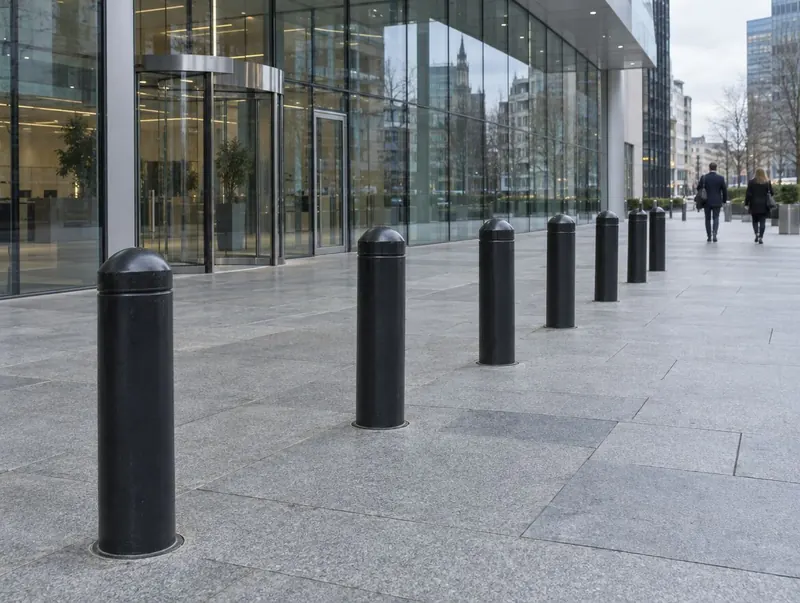 Computer-generated image
About crash-rated bollards in Exmouth
In the town of Exmouth, crash-rated bollards tend to go in at small industrial units, community car parks and schools. The rating only holds when the bollard is installed to the same foundation design that was tested.
We work across EX8 and EX9 — Exmouth itself and places including Lympstone, Budleigh Salterton, Otterton and East Budleigh. We also cover neighbouring Exeter (9.2 miles), Newton Abbot (11 miles), Torquay (12 miles) and Paignton (14.5 miles) — distances are straight-line. Plymouth is around 37 miles away.
Key facts for this area
- Area
- Devon, England
- Highway authority
- Devon County Council (local roads)
- Planning authority
- the council for East Devon
- Postcodes
- EX8 and EX9
- Guide price
- Typically £1,995–£9,995 per bollard + VAT; minimum job £3,995
- Survey
- Free, with a fixed written quote
- Nearby
- Exeter (9.2 mi), Newton Abbot (11 mi), Torquay (12 mi), Paignton (14.5 mi)
Guide prices for Exmouth
| Specification | Guide price | Includes |
|---|---|---|
| Standard | £1,995–£5,345 + VAT | Rated for a 7.5 t vehicle at 30 mph (48 km/h), tested foundation |
| Upgraded | £4,395–£7,745 + VAT | Rated for 7.5 t at 40 mph (64 km/h), tested foundation |
| Premium | £6,795–£9,995 + VAT | Rated for 7.5 t at 50 mph (80 km/h), or a specialist foundation |
Per bollard, supplied and installed on a standard tested foundation; no regional adjustment. Guide only — the fixed price follows a survey.
Typical crash-rated bollards jobs in Exmouth
Around Exmouth, crash-rated bollards usually solve one of these:
- Glazed frontages on corporate and public buildings
- Building entrances and forecourts flagged in a security risk assessment
- Pedestrianised streets, plazas and crowded public spaces
Permissions and groundwork in Exmouth
The highway authority for local roads in Exmouth is Devon County Council; motorways and trunk roads sit with National Highways. Crash-rated bollards on the adopted footway are a matter for the highway authority, so we only install there with its written agreement.
Many private-land installations in Exmouth need no planning application, but the rules don't clearly cover bollards, so listed buildings, conservation areas and prominent frontages are worth raising with the planning team at the council for East Devon before posts go in.
Footways and forecourts in towns are usually crowded with cables, gas mains, water pipes and old drainage, and a single unexpected duct can stop a bollard position. Reinstatement matches paving, tactile surfaces and kerbs.
- Check that the test certificate matches the exact model, configuration and foundation being installed, and keep it with the site records.
- Ask the local planning authority whether consent is needed, particularly in conservation areas or near listed buildings.
How the job runs
Free site survey and ground checks
A free site survey looks at access, surfaces and likely services, followed by utility searches, radar scanning and trial holes where needed. You then receive a fixed written quote based on what the survey found.
Set out and excavate
Positions are set out to the drawing and excavated to the tested depth and width, with shoring where the ground needs it. Spoil is removed as work progresses.
Fix reinforcement and set the posts
The reinforcement cage is built to the drawing and the bollards are held to line and level in templates. Concrete is poured to the specified grade, with samples taken for testing if the specification calls for them.
Specification choices
| Option | Detail |
|---|---|
| Deep or standard foundation designs | Deep foundations suit open ground where excavation is unrestricted. Where services or slabs get in the way, shallow-mount tested designs may be a better fit. |
| Static rated bollards | Fixed posts for permanent lines where vehicles never need to pass. They are a straightforward rated option to install and maintain. |
| Heights and diameters | Exposed heights are commonly around 800 to 1,000 mm, with core diameters varying by model and rating. Larger diameters are not always needed to achieve a given rating. |
What moves the price in Exmouth
Our South West guide prices are a starting point; the survey in Exmouth firms them up. What tends to move them:
- Number of posts and whether a linked beam system is needed
- Reinstatement of natural stone, tactile paving or specialist surfaces
- Buried services, diversions and ground investigation
Looking after them
Keep inspection records with the original test certificate so the line's condition can be shown to insurers or a security adviser. Movable rated bollards need a planned servicing schedule.
For damaged or loose posts in Exmouth, repairs and replacements are priced in writing first.
Common questions
Which parts of Exmouth do you cover for crash-rated bollards?
We cover all of Exmouth (EX8 and EX9) and the rest of Devon. We also work in Exeter, Newton Abbot and Torquay.
Do I need consent for crash-rated bollards on a public footway in Exmouth?
Devon County Council is the highway authority covering Exmouth's local roads. If any post would stand on adopted highway rather than your land, that consent is the first thing we sort out.
How much do crash-rated bollards cost in Exmouth?
In Exmouth, typically £1,995–£9,995 per bollard, supplied and installed on a standard tested foundation, plus VAT, with a minimum job of £3,995 plus VAT, using our South West guide prices. The fixed figure comes in writing after we've seen the site.
Will you design our HVM layout?
No. Scheme design and threat assessment belong with your security adviser, a specialist consultant or the manufacturer's technical team. We install the products they specify, to the tested foundation, and work alongside them on site so the build matches the design.
What does a crash rating code actually tell me?
It tells you the vehicle used in the test, how fast it was travelling, the angle it hit at and how far it got past the bollard line. Your security adviser compares those figures with the vehicle and speed achievable on your approach. A rating that does not match the site's real risk is either more than you need or not enough.