Glasgow City · Scotland
Crash-rated bollard installation in Glasgow
Crash-rated bollards supplied and fitted in Glasgow, Glasgow City: surveyed, scanned for services, set in proper foundations and finished to match the ground.
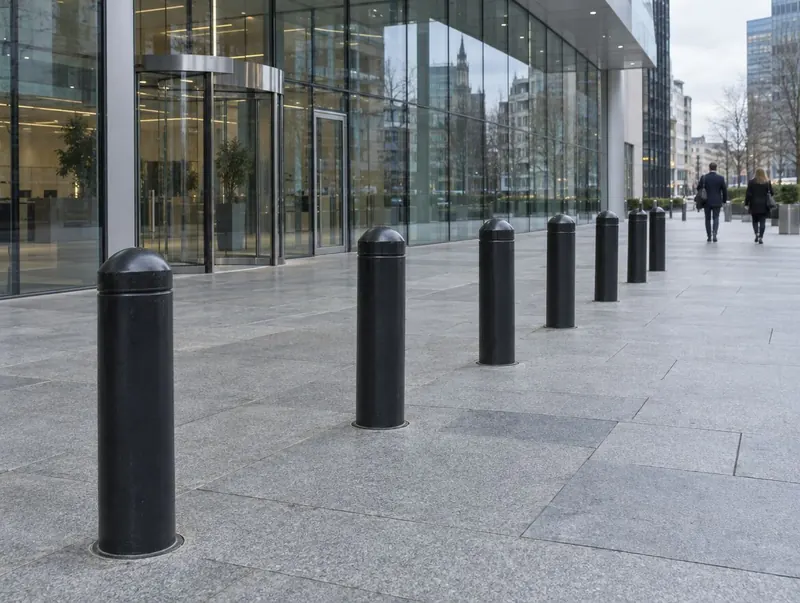 Computer-generated image
Crash-rated bollards in Glasgow
Installation of impact-tested HVM bollards rated to ISO 22343-1 (or the superseded, still-accepted PAS 68 / IWA 14-1) on the tested foundation. In Glasgow, that tends to mean sites such as retail parks, stadium approaches and university campuses.
We cover every part of Glasgow in the G2, G4, G1, G3, G5 and G20 postcode districts. Nearby, we also work in Rutherglen (3 miles), Bishopbriggs (3.2 miles), Bearsden (4.5 miles) and Giffnock (4.5 miles), measured as the crow flies.
Glasgow at a glance
- Area
- Glasgow City, Scotland
- Roads authority
- Glasgow City Council (local roads)
- Planning authority
- Glasgow City Council
- Postcodes
- G2, G4, G1, G3, G5, G20, G22 and G21
- Guide price
- Typically £1,995–£9,995 per bollard + VAT; minimum job £3,995
- Survey
- Free, with a fixed written quote
- Nearby
- Rutherglen (3 mi), Bishopbriggs (3.2 mi), Bearsden (4.5 mi), Giffnock (4.5 mi)
What Glasgow sites use crash-rated bollards for
Around Glasgow, crash-rated bollards usually solve one of these:
- Pedestrianised streets, plazas and crowded public spaces
- Glazed frontages on corporate and public buildings
- Transport interchanges, taxi ranks and drop-off zones
Crash-rated bollard prices in Glasgow
| Specification | Guide price | Includes |
|---|---|---|
| Standard | £1,995–£5,345 + VAT | Rated for a 7.5 t vehicle at 30 mph (48 km/h), tested foundation |
| Upgraded | £4,395–£7,745 + VAT | Rated for 7.5 t at 40 mph (64 km/h), tested foundation |
| Premium | £6,795–£9,995 + VAT | Rated for 7.5 t at 50 mph (80 km/h), or a specialist foundation |
Per bollard, supplied and installed on a standard tested foundation; no regional adjustment. Guide only — the fixed price follows a survey.
What we check first in Glasgow
For anything on the public footway in Glasgow we check with the roads authority first — Glasgow City Council for local roads, Transport Scotland on trunk routes. Private ground such as a car park or forecourt only needs the owner's go-ahead.
Many private-land installations in Glasgow need no planning application, but the rules don't clearly cover bollards, so listed buildings, conservation areas and prominent frontages are worth raising with the planning team at Glasgow City Council before posts go in.
Footways and forecourts in towns are usually crowded with cables, gas mains, water pipes and old drainage, and a single unexpected duct can stop a bollard position. Made ground, a high water table or soft clay may need an engineer to confirm the tested design suits the site; any change to depth, width or reinforcement must be agreed in writing by the manufacturer, or the rating may no longer apply.
- Confirm who owns the land: works on public highway usually need the roads authority's agreement, and permanent street furniture there may need a licence.
- Agree how emergency vehicles will get through, and refer to guidance on selecting and installing vehicle security barriers such as PAS 69 or ISO 22343-2.
How the job runs
Start from the specification
We work from the specification issued by your security adviser or the manufacturer: product, rating, positions and foundation drawing. If no specification exists yet, we can put you in touch with the manufacturer's technical team, but we do not set the threat level ourselves.
Set out and excavate
Positions are set out to the drawing and excavated to the tested depth and width, with shoring where the ground needs it. Spoil is removed as work progresses.
Hand over a build record
You receive photographs of the reinforcement and excavation before each pour, concrete delivery tickets, as-built positions and the manufacturer's product certification, ready for your adviser and insurers.
Choosing the right spec
| Option | Detail |
|---|---|
| Heights and diameters | Exposed heights are commonly around 800 to 1,000 mm, with core diameters varying by model and rating. Larger diameters are not always needed to achieve a given rating. |
| Decorative covers | Stainless steel, cast or polymer sleeves can be fitted over the steel core to suit a streetscape. Use covers supplied or approved by the manufacturer so the tested product is not altered. |
| Static rated bollards | Fixed posts for permanent lines where vehicles never need to pass. They are a straightforward rated option to install and maintain. |
What moves the price in Glasgow
When we price crash-rated bollards in Glasgow, these make the biggest difference:
- Buried services, diversions and ground investigation
- Covers, finishes and any integrated lighting
- Traffic management, restricted working hours or night work in occupied sites
After installation
Look for cracked surfacing at the base, movement, damaged covers and faded bands. Static rated bollards need little routine work, but they should be inspected periodically and always after any impact.
If posts in Glasgow are later hit or damaged, we can repair or replace them — see bollard repairs.
Questions about crash-rated bollards in Glasgow
Can you install crash-rated bollards anywhere in Glasgow?
We cover all of Glasgow (G2, G4, G1, G3, G5 and G20) and the rest of Glasgow City. We also work in Rutherglen, Bishopbriggs and Bearsden.
Do I need consent for crash-rated bollards on a public footway in Glasgow?
Glasgow falls under Glasgow City Council as roads authority. If the line of posts crosses onto adopted road or pavement, permission comes before excavation; on private land it does not.
How much do crash-rated bollards cost in Glasgow?
In Glasgow, typically £1,995–£9,995 per bollard, supplied and installed on a standard tested foundation, plus VAT, with a minimum job of £3,995 plus VAT, using our Scotland guide prices. The fixed figure comes in writing after we've seen the site.
Is a heavy unrated steel post good enough instead?
Not where the risk is a deliberate vehicle attack. An unrated post may look solid, but nobody can say what it will stop because it has never been tested with its foundation. Unrated steel suits nuisance parking and low-speed knocks, not crowds or buildings flagged in a security assessment.
When can we rely on the new bollards?
Only once the concrete has reached the strength set in the specification. The posts are physically in place as soon as the pour is finished, but the rated performance depends on the foundation, and full design strength is commonly taken at around 28 days. Your adviser may arrange temporary measures to cover the gap.
Crash-rated bollards in nearby towns
- Rutherglen (3 mi)
- Bishopbriggs (3.2 mi)
- Bearsden (4.5 mi)
- Giffnock (4.5 mi)
- Renfrew (5.3 mi)
- Cambuslang (5.4 mi)