Kent · England
Crash-rated bollard installation in Deal
Crash-rated bollards for sites across Deal and the rest of Kent, from the first measurement to the last relaid paving block.
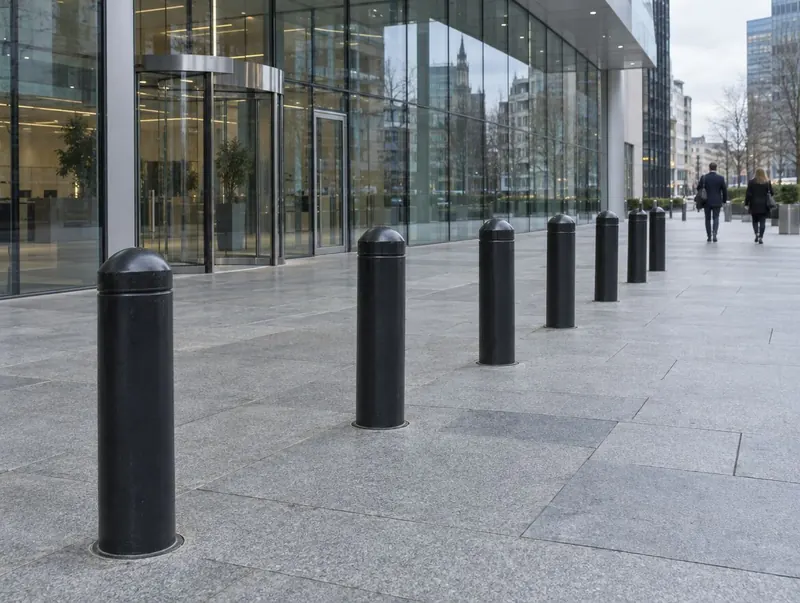 Computer-generated image
Deal crash-rated bollards
Across Deal, typical sites for crash-rated bollards include community car parks, town-centre squares and schools. Installation of impact-tested HVM bollards rated to ISO 22343-1 (or the superseded, still-accepted PAS 68 / IWA 14-1) on the tested foundation.
Coverage in Deal takes in the CT14 and CT13 postcode districts and nearby places like Sholden, Ringwould, Tilmanstone and Ripple. Jobs in Deal can be combined with work in Dover (7.8 miles), Ramsgate (7.8 miles), Broadstairs (9.5 miles) and Margate (11 miles) (straight-line distances).
Local details
- Area
- Kent, England
- Highway authority
- Kent County Council (local roads)
- Planning authority
- the council for Dover
- Postcodes
- CT14 and CT13
- Guide price
- Typically £2,095–£10,595 per bollard + VAT; minimum job £4,245
- Survey
- Free, with a fixed written quote
- Nearby
- Dover (7.8 mi), Ramsgate (7.8 mi), Broadstairs (9.5 mi), Margate (11 mi)
Where crash-rated bollards go in around Deal
Common uses in a place like Deal:
- Stadiums, arenas and event venues with predictable crowd flows
- Glazed frontages on corporate and public buildings
- Building entrances and forecourts flagged in a security risk assessment
Guide prices for Deal
| Specification | Guide price | Includes |
|---|---|---|
| Standard | £2,095–£5,695 + VAT | Rated for a 7.5 t vehicle at 30 mph (48 km/h), tested foundation |
| Upgraded | £4,645–£8,245 + VAT | Rated for 7.5 t at 40 mph (64 km/h), tested foundation |
| Premium | £7,195–£10,595 + VAT | Rated for 7.5 t at 50 mph (80 km/h), or a specialist foundation |
Per bollard, supplied and installed on a standard tested foundation; +6% for South East. Guide only — the fixed price follows a survey.
Permissions and groundwork in Deal
The highway authority for local roads in Deal is Kent County Council; motorways and trunk roads sit with National Highways. Crash-rated bollards on the adopted footway are a matter for the highway authority, so we only install there with its written agreement.
Bollards on private land often don't need planning permission, but it depends on the council's view, the height and the location; in a conservation area, next to a listed building or under an Article 4 direction, ask the local planning authority (the council for Dover) first — we flag this at survey.
Rated foundations are large, and excavation is often where projects run into trouble. Utility records, radar scanning and hand-dug trial holes come before any machine work, and service diversions can take longer than the bollard installation itself.
- Check that the test certificate matches the exact model, configuration and foundation being installed, and keep it with the site records.
- Ask the local planning authority whether consent is needed, particularly in conservation areas or near listed buildings.
What happens on site
Start from the specification
We work from the specification issued by your security adviser or the manufacturer: product, rating, positions and foundation drawing. If no specification exists yet, we can put you in touch with the manufacturer's technical team, but we do not set the threat level ourselves.
Cure, protect and reinstate
The posts are protected while the concrete gains strength, and the surface is reinstated to match. The line should not be treated as fully effective until the specified curing period has passed.
Hand over a build record
You receive photographs of the reinforcement and excavation before each pour, concrete delivery tickets, as-built positions and the manufacturer's product certification, ready for your adviser and insurers.
Finishes and options
| Option | Detail |
|---|---|
| Static rated bollards | Fixed posts for permanent lines where vehicles never need to pass. They are a straightforward rated option to install and maintain. |
| Deep or standard foundation designs | Deep foundations suit open ground where excavation is unrestricted. Where services or slabs get in the way, shallow-mount tested designs may be a better fit. |
| Decorative covers | Stainless steel, cast or polymer sleeves can be fitted over the steel core to suit a streetscape. Use covers supplied or approved by the manufacturer so the tested product is not altered. |
Pricing crash-rated bollards in Deal
When we price crash-rated bollards in Deal, these make the biggest difference:
- Reinstatement of natural stone, tactile paving or specialist surfaces
- Traffic management, restricted working hours or night work in occupied sites
- Number of posts and whether a linked beam system is needed
Keeping them working
A rated bollard that has stopped a vehicle has done its job and should be assessed with the manufacturer; in most cases the post, and sometimes the foundation insert, is replaced rather than straightened. Keep inspection records with the original test certificate so the line's condition can be shown to insurers or a security adviser.
For damaged or loose posts in Deal, repairs and replacements are priced in writing first.
Common questions
Which parts of Deal do you cover for crash-rated bollards?
We cover all of Deal (CT14 and CT13) and the rest of Kent. We also work in Dover, Ramsgate and Broadstairs.
Do I need consent for crash-rated bollards on a public footway in Deal?
Kent County Council is the highway authority covering Deal's local roads. If any post would stand on adopted highway rather than your land, that consent is the first thing we sort out.
How much do crash-rated bollards cost in Deal?
In Deal, typically £2,095–£10,595 per bollard, supplied and installed on a standard tested foundation, plus VAT, with a minimum job of £4,245 plus VAT, using our South East guide prices. The fixed figure comes in writing after we've seen the site.
Will you design our HVM layout?
No. Scheme design and threat assessment belong with your security adviser, a specialist consultant or the manufacturer's technical team. We install the products they specify, to the tested foundation, and work alongside them on site so the build matches the design.
What does a crash rating code actually tell me?
It tells you the vehicle used in the test, how fast it was travelling, the angle it hit at and how far it got past the bollard line. Your security adviser compares those figures with the vehicle and speed achievable on your approach. A rating that does not match the site's real risk is either more than you need or not enough.
Crash-rated bollards near Deal
- Dover (7.8 mi)
- Ramsgate (7.8 mi)
- Broadstairs (9.5 mi)
- Margate (11 mi)
- Folkestone (14.1 mi)
- Canterbury (14.5 mi)