Kent · England
Crash-rated bollard installation in Broadstairs
Local installation of crash-rated bollards in Broadstairs — free survey, fixed written price, and posts set to the right spacing for people and vehicles.
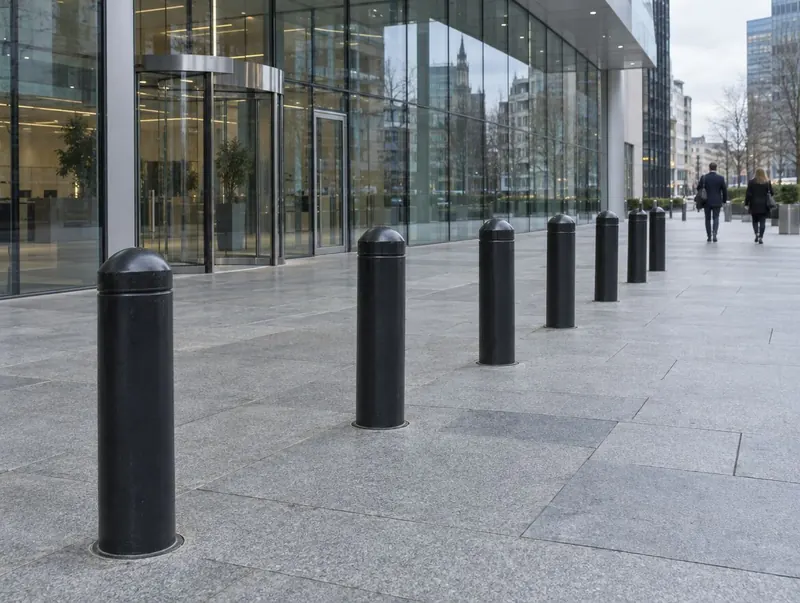 Computer-generated image
Broadstairs crash-rated bollards
We supply and fit crash-rated bollards throughout Broadstairs, typically for sites such as high street shopfronts, town-centre squares and community car parks. Installation of impact-tested HVM bollards rated to ISO 22343-1 (or the superseded, still-accepted PAS 68 / IWA 14-1) on the tested foundation.
We cover the CT10 postcode district in Broadstairs. Jobs in Broadstairs can be combined with work in Ramsgate (1.9 miles), Margate (2.9 miles), Deal (9.5 miles) and Herne Bay (13.6 miles) (straight-line distances).
Broadstairs at a glance
- Area
- Kent, England
- Highway authority
- Kent County Council (local roads)
- Planning authority
- the council for Thanet
- Postcodes
- CT10
- Guide price
- Typically £2,095–£10,595 per bollard + VAT; minimum job £4,245
- Survey
- Free, with a fixed written quote
Guide prices for Broadstairs
| Specification | Guide price | Includes |
|---|---|---|
| Standard | £2,095–£5,695 + VAT | Rated for a 7.5 t vehicle at 30 mph (48 km/h), tested foundation |
| Upgraded | £4,645–£8,245 + VAT | Rated for 7.5 t at 40 mph (64 km/h), tested foundation |
| Premium | £7,195–£10,595 + VAT | Rated for 7.5 t at 50 mph (80 km/h), or a specialist foundation |
Per bollard, supplied and installed on a standard tested foundation; +6% for South East. Guide only — the fixed price follows a survey.
Crash-rated bollards in Broadstairs: common uses
Common uses in a place like Broadstairs:
- Sites where a vehicle dynamics assessment shows a long straight run-up
- Glazed frontages on corporate and public buildings
- Stadiums, arenas and event venues with predictable crowd flows
What we check first in Broadstairs
Kent County Council is the highway authority covering Broadstairs's local roads. If any post would stand on adopted highway rather than your land, that consent is the first thing we sort out.
If your site in Broadstairs is listed or inside a conservation area, check with the local planning authority (the council for Thanet) before choosing a finish — heritage settings often favour cast iron or painted steel over stainless.
Rated foundations are large, and excavation is often where projects run into trouble. Reinstatement matches paving, tactile surfaces and kerbs.
- Confirm who owns the land: works on public highway usually need the highway authority's agreement, and permanent street furniture there may need a licence.
- Balance the gaps: narrow enough to stop a vehicle, typically no more than about 1,200 mm, but wide enough for wheelchair users and buggies — check against Inclusive Mobility guidance.
Installation, step by step
Set out and excavate
Positions are set out to the drawing and excavated to the tested depth and width, with shoring where the ground needs it. Spoil is removed as work progresses.
Fix reinforcement and set the posts
The reinforcement cage is built to the drawing and the bollards are held to line and level in templates. Concrete is poured to the specified grade, with samples taken for testing if the specification calls for them.
Hand over a build record
You receive photographs of the reinforcement and excavation before each pour, concrete delivery tickets, as-built positions and the manufacturer's product certification, ready for your adviser and insurers.
Finishes and options
| Option | Detail |
|---|---|
| Decorative covers | Stainless steel, cast or polymer sleeves can be fitted over the steel core to suit a streetscape. Use covers supplied or approved by the manufacturer so the tested product is not altered. |
| Rated removable or automatic posts | Where an entrance must open for deliveries or emergency vehicles, rated removable, retractable or automatic models are available. Check that the rating stated is for the exact model and position you are buying. |
| Finishes and visibility bands | Galvanised and powder-coated finishes in RAL colours, with contrasting or reflective bands near the top so the posts are visible to pedestrians and drivers. |
What affects the quote
Our South East guide prices are a starting point; the survey in Broadstairs firms them up. What tends to move them:
- Buried services, diversions and ground investigation
- Reinstatement of natural stone, tactile paving or specialist surfaces
- Number of posts and whether a linked beam system is needed
After installation
Keep inspection records with the original test certificate so the line's condition can be shown to insurers or a security adviser. Movable rated bollards need a planned servicing schedule.
If posts in Broadstairs are later hit or damaged, we can repair or replace them — see bollard repairs.
Common questions
Which parts of Broadstairs do you cover for crash-rated bollards?
We cover all of Broadstairs (CT10) and the rest of Kent. We also work in Ramsgate, Margate and Deal.
Who gives permission for bollards on the pavement in Broadstairs?
Kent County Council is the highway authority covering Broadstairs's local roads. If any post would stand on adopted highway rather than your land, that consent is the first thing we sort out.
How much do crash-rated bollards cost in Broadstairs?
In Broadstairs, typically £2,095–£10,595 per bollard, supplied and installed on a standard tested foundation, plus VAT, with a minimum job of £4,245 plus VAT, using our South East guide prices. The fixed figure comes in writing after we've seen the site.
Why can't the foundation be adjusted to suit our ground?
Because the rating belongs to the bollard and foundation as tested together. Making the hole shallower, narrower or lighter on steel changes how the system behaves on impact. If site conditions force a change, the manufacturer has to approve it in writing, and some changes mean choosing a different product such as a shallow-mount system.
When can we rely on the new bollards?
Only once the concrete has reached the strength set in the specification. The posts are physically in place as soon as the pour is finished, but the rated performance depends on the foundation, and full design strength is commonly taken at around 28 days. Your adviser may arrange temporary measures to cover the gap.