London · England
Crash-rated bollard installation in Islington
Local installation of crash-rated bollards in Islington — free survey, fixed written price, and posts set to the right spacing for people and vehicles.
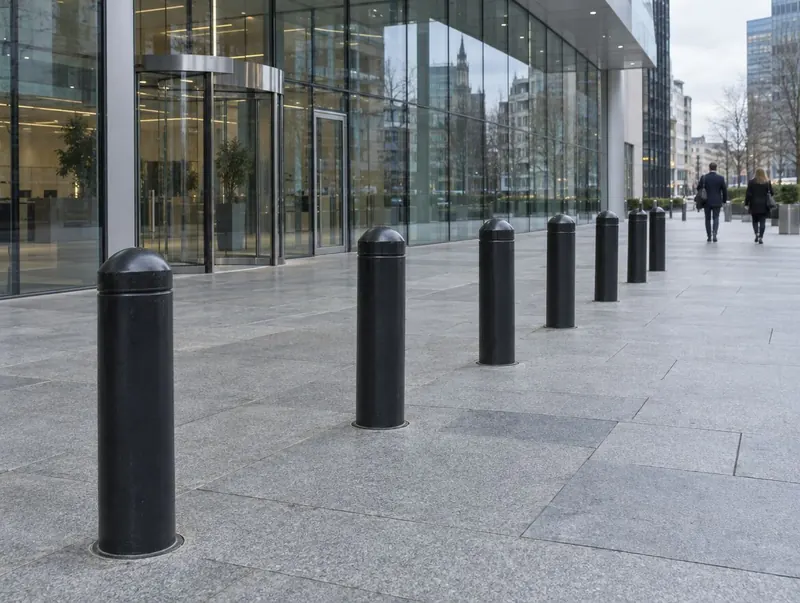 Computer-generated image
About crash-rated bollards in Islington
Across Islington, typical sites for crash-rated bollards include hospital approaches, estate car parks and office entrances. The rating only holds when the bollard is installed to the same foundation design that was tested.
Coverage in Islington takes in the N5, N1, N7, EC1V, EC1R and EC1Y postcode districts. Jobs in Islington can be combined with work in City of London (2.2 miles), Hackney (2.3 miles), Camden (2.6 miles) and Haringey (2.8 miles) (straight-line distances).
Local details
- Area
- London, England
- Highway authority
- Islington Council (local roads)
- Planning authority
- Islington Council
- Postcodes
- N5, N1, N7, EC1V, EC1R, EC1Y, N19 and EC2A
- Guide price
- Typically £2,295–£11,495 per bollard + VAT; minimum job £4,595
- Survey
- Free, with a fixed written quote
- Nearby
- City of London (2.2 mi), Hackney (2.3 mi), Camden (2.6 mi), Haringey (2.8 mi)
Crash-rated bollard prices in Islington
| Specification | Guide price | Includes |
|---|---|---|
| Standard | £2,295–£6,145 + VAT | Rated for a 7.5 t vehicle at 30 mph (48 km/h), tested foundation |
| Upgraded | £5,045–£8,895 + VAT | Rated for 7.5 t at 40 mph (64 km/h), tested foundation |
| Premium | £7,795–£11,495 + VAT | Rated for 7.5 t at 50 mph (80 km/h), or a specialist foundation |
Per bollard, supplied and installed on a standard tested foundation; +15% for London. Guide only — the fixed price follows a survey.
What Islington sites use crash-rated bollards for
Common uses in a place like Islington:
- Data centres, utilities and critical infrastructure perimeters
- Sites where a vehicle dynamics assessment shows a long straight run-up
- Building entrances and forecourts flagged in a security risk assessment
Permissions and groundwork in Islington
Islington Council is the highway authority covering Islington's local roads. Red routes are managed by Transport for London. If any post would stand on adopted highway rather than your land, that consent is the first thing we sort out.
Bollards on private land often don't need planning permission, but it depends on the council's view, the height and the location; in a conservation area, next to a listed building or under an Article 4 direction, ask the local planning authority (Islington Council) first — we flag this at survey.
Utility records, radar scanning and hand-dug trial holes come before any machine work, and service diversions can take longer than the bollard installation itself. Rated foundations are large, and excavation is often where projects run into trouble.
- Balance the gaps: narrow enough to stop a vehicle, typically no more than about 1,200 mm, but wide enough for wheelchair users and buggies — check against Inclusive Mobility guidance.
- Ask the local planning authority whether consent is needed, particularly in conservation areas or near listed buildings.
How the job runs
Start from the specification
We work from the specification issued by your security adviser or the manufacturer: product, rating, positions and foundation drawing. If no specification exists yet, we can put you in touch with the manufacturer's technical team, but we do not set the threat level ourselves.
Set out and excavate
Positions are set out to the drawing and excavated to the tested depth and width, with shoring where the ground needs it. Spoil is removed as work progresses.
Hand over a build record
You receive photographs of the reinforcement and excavation before each pour, concrete delivery tickets, as-built positions and the manufacturer's product certification, ready for your adviser and insurers.
Choosing the right spec
| Option | Detail |
|---|---|
| Deep or standard foundation designs | Deep foundations suit open ground where excavation is unrestricted. Where services or slabs get in the way, shallow-mount tested designs may be a better fit. |
| Decorative covers | Stainless steel, cast or polymer sleeves can be fitted over the steel core to suit a streetscape. Use covers supplied or approved by the manufacturer so the tested product is not altered. |
| Static rated bollards | Fixed posts for permanent lines where vehicles never need to pass. They are a straightforward rated option to install and maintain. |
Pricing crash-rated bollards in Islington
Two Islington jobs with the same number of posts can price quite differently. The usual reasons:
- Reinstatement of natural stone, tactile paving or specialist surfaces
- Covers, finishes and any integrated lighting
- Buried services, diversions and ground investigation
Keeping them working
A rated bollard that has stopped a vehicle has done its job and should be assessed with the manufacturer; in most cases the post, and sometimes the foundation insert, is replaced rather than straightened. Look for cracked surfacing at the base, movement, damaged covers and faded bands.
We can also service, repair or replace existing posts anywhere in Islington.
Questions about crash-rated bollards in Islington
Can you install crash-rated bollards anywhere in Islington?
We cover all of Islington (N5, N1, N7, EC1V, EC1R and EC1Y) and the rest of London. We also work in City of London, Hackney and Camden.
Who gives permission for bollards on the pavement in Islington?
Islington Council is the highway authority covering Islington's local roads. Red routes are managed by Transport for London. If any post would stand on adopted highway rather than your land, that consent is the first thing we sort out.
How much do crash-rated bollards cost in Islington?
In Islington, typically £2,295–£11,495 per bollard, supplied and installed on a standard tested foundation, plus VAT, with a minimum job of £4,595 plus VAT, using our London guide prices. The fixed figure comes in writing after we've seen the site.
Is a heavy unrated steel post good enough instead?
Not where the risk is a deliberate vehicle attack. An unrated post may look solid, but nobody can say what it will stop because it has never been tested with its foundation. Unrated steel suits nuisance parking and low-speed knocks, not crowds or buildings flagged in a security assessment.
When can we rely on the new bollards?
Only once the concrete has reached the strength set in the specification. The posts are physically in place as soon as the pour is finished, but the rated performance depends on the foundation, and full design strength is commonly taken at around 28 days. Your adviser may arrange temporary measures to cover the gap.
Crash-rated bollards in nearby towns
- City of London (2.2 mi)
- Hackney (2.3 mi)
- Camden (2.6 mi)
- Haringey (2.8 mi)
- Westminster (3.3 mi)
- Tower Hamlets (3.6 mi)