Perth and Kinross · Scotland
Semi-automatic bollard installation in Perth
Semi-automatic bollards for sites across Perth and the rest of Perth and Kinross, from the first measurement to the last relaid paving block.
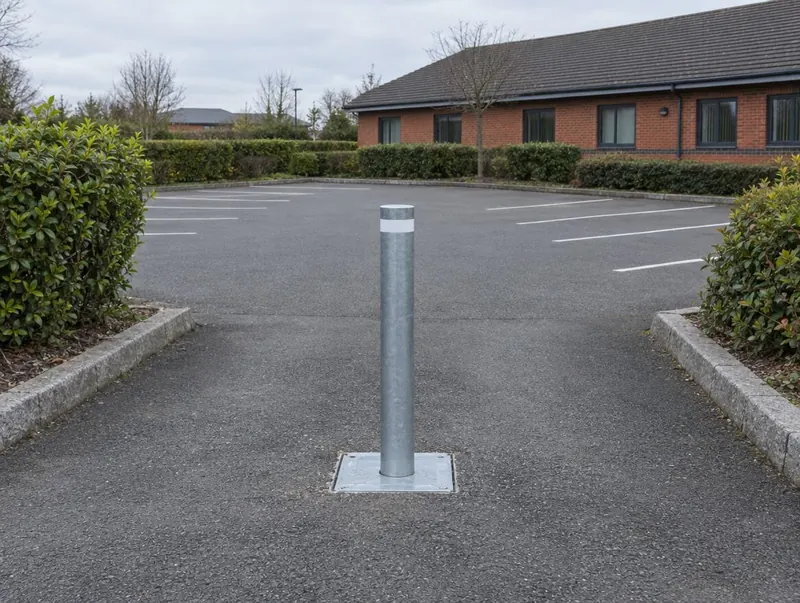 Computer-generated image
About semi-automatic bollards in Perth
Whether it's community buildings, schools and residential driveways, semi-automatic bollards in Perth are planned around who needs to get through and who doesn't. Gas-strut assisted bollards that rise on their own when unlocked and lower by hand, with no mains power needed.
Coverage in Perth takes in the PH2 and PH1 postcode districts and nearby places like Scone, Bridge of Earn, Errol and Abernethy. Nearby, we also work in Blairgowrie (14 miles), Glenrothes (17 miles), Dundee (18.2 miles) and Cowdenbeath (19.9 miles), measured as the crow flies.
Key facts for this area
- Area
- Perth and Kinross, Scotland
- Roads authority
- Perth and Kinross Council (local roads)
- Planning authority
- Perth and Kinross Council
- Postcodes
- PH2 and PH1
- Guide price
- Typically £1,095–£3,495 per bollard + VAT (£1,295–£4,195 inc VAT for homes); minimum job £1,195
- Survey
- Free, with a fixed written quote
- Nearby
- Blairgowrie (14 mi), Glenrothes (17 mi), Dundee (18.2 mi), Cowdenbeath (19.9 mi)
Where semi-automatic bollards go in around Perth
Typical reasons Perth sites choose semi-automatic bollards:
- Private roads and courtyards with a small number of key holders
- Driveways where the owner wants minimal effort
- Locations where automatic bollards are not justified
Guide prices for Perth
| Specification | Guide price | Includes |
|---|---|---|
| Standard | £1,095–£2,095 + VAT · £1,295–£2,495 inc VAT | Standard post, foundation, reinstatement |
| Upgraded | £1,795–£2,845 + VAT · £2,145–£3,395 inc VAT | Upgraded finish or fittings, reflective band, matched keys |
| Premium | £2,545–£3,495 + VAT · £3,045–£4,195 inc VAT | Heavy-duty or architectural spec, premium finish |
Per bollard, supplied and installed; no regional adjustment. Guide only — the fixed price follows a survey.
Before we dig in Perth
For anything on the public footway in Perth we check with the roads authority first — Perth and Kinross Council for local roads, Transport Scotland on trunk routes. Private ground such as a car park or forecourt only needs the owner's go-ahead.
Bollards on private land often need no planning application, but listed buildings and conservation areas are different; the planning service at Perth and Kinross Council can confirm before anything is ordered.
Buried services across the entrance are traced and the position adjusted if needed, as the cassette cannot simply be made shallower. On sandy or gravel ground a soakaway beneath the cassette often drains it adequately; on clay, chalk with poor drainage or where groundwater rises, a pipe to a surface water drain or a dedicated soakaway is needed.
- Warn users and passers-by that the post rises on its own; fit reflective bands and consider a sign at busy sites.
- Agree how emergency services will gain access if the post is locked up.
From survey to handover
Survey use and ground
At the free site survey we look at how often the post will be used, who will operate it and what is under the surface. A fixed written quote follows, including drainage.
Excavate the pit
The surface is cut and the pit dug to the cassette depth plus a drainage layer, by hand near services.
Test and show users
The post is cycled several times to check it rises fully, locks at both heights and lowers smoothly. Users are shown how to operate it and to keep clear of the head when it rises.
Finishes and options
| Option | Detail |
|---|---|
| Duty level | Light-duty domestic models and heavier commercial versions with stronger cassettes and posts. |
| Height and diameter | Raised heights commonly around 500–900 mm and diameters around 100–200 mm, depending on model and duty. |
| Gas strut or spring assist | Most models use a gas strut; some use springs. Both store energy to raise the post when unlocked. |
What moves the price in Perth
When we price semi-automatic bollards in Perth, these make the biggest difference:
- Surface reinstatement
- Finish and any head lighting
- Number of posts and keyed-alike locks
Looking after them
In winter, keep an eye on the lid after frost or snow; ice around the head can stop the post rising, and forcing the key or the post at that point damages the latch. Operate the bollard regularly and keep the head and lid clear of grit.
If posts in Perth are later hit or damaged, we can repair or replace them — see bollard repairs.
Common questions
Which parts of Perth do you cover for semi-automatic bollards?
We cover all of Perth (PH2 and PH1) and the rest of Perth and Kinross. We also work in Blairgowrie, Glenrothes and Dundee.
Do I need consent for semi-automatic bollards on a public footway in Perth?
For anything on the public footway in Perth we check with the roads authority first — Perth and Kinross Council for local roads, Transport Scotland on trunk routes. Private ground such as a car park or forecourt only needs the owner's go-ahead.
What's a typical price for semi-automatic bollards in Perth?
In Perth, typically £1,095–£3,495 per bollard, supplied and installed, plus VAT (£1,295–£4,195 including VAT for homeowners), with a minimum job of £1,195 plus VAT, using our Scotland guide prices. The fixed figure comes in writing after we've seen the site.
What makes a semi-automatic bollard rise without power?
A gas strut or spring inside the cassette. Pushing the post down compresses it and a latch holds the post below ground. Turning the key releases the latch and the stored energy lifts the post.
Do semi-automatic bollards suit domestic driveways?
Yes, if the owner wants less lifting than a telescopic post. The same depth and drainage checks apply. Domestic models are lighter duty than commercial ones.
Semi-automatic bollards near Perth
- Blairgowrie (14 mi)
- Glenrothes (17 mi)
- Dundee (18.2 mi)
- Cowdenbeath (19.9 mi)
- Methil (21.4 mi)
- Kirkcaldy (21.9 mi)