Oxfordshire · England
Telescopic bollard installation in Oxford
Planning telescopic bollards in Oxford? We check ownership, consents and buried services first, then quote a fixed price.
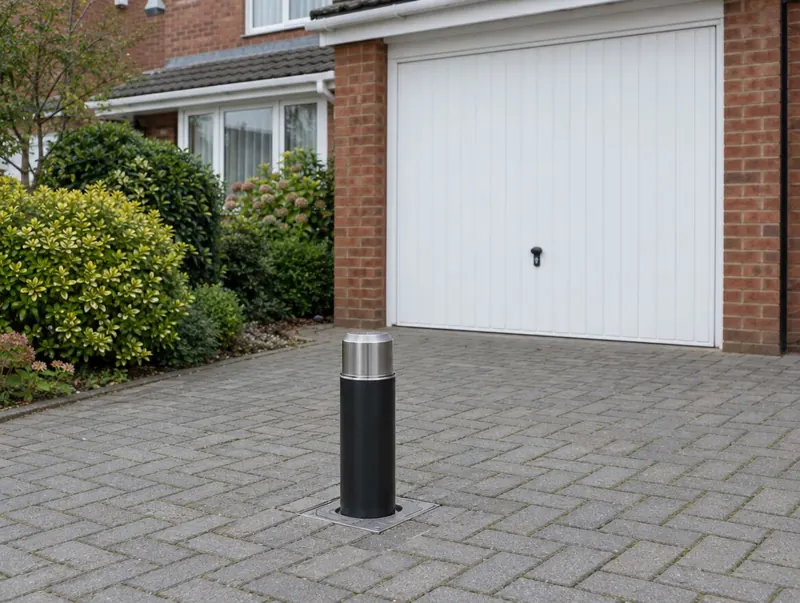 Computer-generated image
About telescopic bollards in Oxford
We supply and fit telescopic bollards throughout Oxford, typically for sites such as city-centre plazas, multi-storey car parks and distribution parks. Key-locked telescopic bollards that retract into a ground cassette, for driveways, private bays and access roads.
We cover Oxford's OX1, OX2, OX3 and OX4 postcode districts, including places such as Wolvercote and Sandford-on-Thames. We also cover neighbouring Abingdon (5.7 miles), Didcot (9.9 miles), Witney (10 miles) and Bicester (11.1 miles) — distances are straight-line. It sits roughly 24 miles from Reading as the crow flies.
Key facts for this area
- Area
- Oxfordshire, England
- Highway authority
- Oxfordshire County Council (local roads)
- Planning authority
- Oxfordshire County Council
- Postcodes
- OX1, OX2, OX3 and OX4
- Guide price
- Typically £365–£1,245 per bollard + VAT (£435–£1,495 inc VAT for homes); minimum job £675
- Survey
- Free, with a fixed written quote
Oxford: typical telescopic bollard prices
| Specification | Guide price | Includes |
|---|---|---|
| Standard | £365–£745 + VAT · £435–£885 inc VAT | Standard post, foundation, reinstatement |
| Upgraded | £635–£995 + VAT · £755–£1,195 inc VAT | Upgraded finish or fittings, reflective band, matched keys |
| Premium | £905–£1,245 + VAT · £1,095–£1,495 inc VAT | Heavy-duty or architectural spec, premium finish |
Per bollard with cassette, supplied and installed; +6% for South East. Guide only — the fixed price follows a survey.
Typical telescopic bollards jobs in Oxford
Common uses in a place like Oxford:
- Car parks where a removable post would go missing
- Allocated parking bays in flats and private developments
- Access roads closed outside working hours
Before we dig in Oxford
Oxfordshire County Council is the highway authority covering Oxford's local roads. If any post would stand on adopted highway rather than your land, that consent is the first thing we sort out.
Bollards on private land often don't need planning permission, but it depends on the council's view, the height and the location; in a conservation area, next to a listed building or under an Article 4 direction, ask the local planning authority (Oxfordshire County Council) first — we flag this at survey.
Telescopic bollards need a deeper excavation than other manual bollards, so ground and services decide where they can go. Positions are scanned and hand-dug before committing.
- If the drive is shared, agree positions and keys with the other users first.
- Confirm the bollard is on your land; bollards on a public footway or dropped kerb need the highway authority's agreement.
What happens on site
Cut and excavate
The surface is cut neatly and the hole dug to the cassette's full depth plus a drainage layer, with care near any service that crosses the drive.
Form the drainage
A gravel soakaway is placed beneath the cassette, or a pipe is laid to a surface water drain or new soakaway.
Reinstate and test
The surface is made good to match. The post is raised, locked, lowered and locked several times to confirm smooth operation, and keys are handed over.
Finishes and options
| Option | Detail |
|---|---|
| Standard or lift-assisted | Lift-assisted models use a spring or counterweight so the post rises with little effort, useful for daily domestic use. |
| Lock types | Keyed cylinder locks, often with a cover to keep out dirt; keyed alike for multi-bay sites where one key should open every post. |
| Finishes | Galvanised, powder-coated in common colours, or stainless steel to suit the frontage. |
What moves the price in Oxford
Our South East guide prices are a starting point; the survey in Oxford firms them up. What tends to move them:
- Number of posts and keyed-alike locks
- Surface type and quality of reinstatement
- Post size and whether lift assistance is wanted
Keeping them working
Clear leaves and grit from around the lid, and a few times a year lift the post fully and look into the cassette for standing water or silt. If the post becomes stiff or will not lower fully, the usual causes are debris in the cassette or a blocked drain, both of which are easier to fix early than after the post has seized.
We can also service, repair or replace existing posts anywhere in Oxford.
Telescopic bollards in Oxford: FAQs
Do you install telescopic bollards in Oxford?
We cover all of Oxford (OX1, OX2, OX3 and OX4) and the rest of Oxfordshire. We also work in Abingdon, Didcot and Witney.
Who gives permission for bollards on the pavement in Oxford?
The highway authority for local roads in Oxford is Oxfordshire County Council; motorways and trunk roads sit with National Highways. Telescopic bollards on the adopted footway are a matter for the highway authority, so we only install there with its written agreement.
How much do telescopic bollards cost in Oxford?
In Oxford, typically £365–£1,245 per bollard with cassette, supplied and installed, plus VAT (£435–£1,495 including VAT for homeowners), with a minimum job of £675 plus VAT, using our South East guide prices. The fixed figure comes in writing after we've seen the site.
How deep does a telescopic bollard go into the ground?
Usually around the exposed height of the post plus the cassette base and drainage layer, which often comes to a metre or more. The exact depth depends on the model. That depth is why we check for services under the drive first.
Is a telescopic bollard harder to lift than a removable one?
Usually easier, because you only lift it up a short distance within its cassette and many models have lift assistance. You also never carry it or store it anywhere.
Telescopic bollards in nearby towns
- Abingdon (5.7 mi)
- Didcot (9.9 mi)
- Witney (10 mi)
- Bicester (11.1 mi)
- Aylesbury (19.4 mi)
- Banbury (21.8 mi)