Flintshire · Wales
Concrete bollard installation in Mold
Planning concrete bollards in Mold? We check ownership, consents and buried services first, then quote a fixed price.
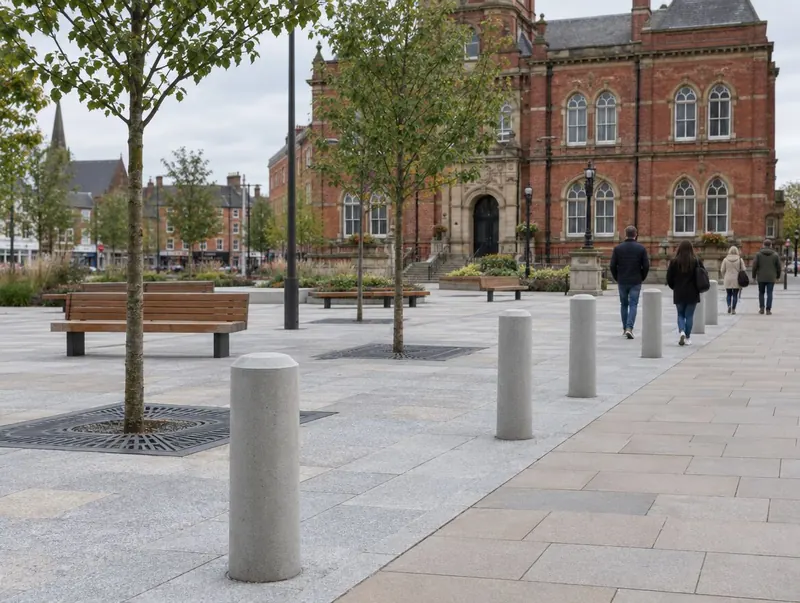 Computer-generated image
Mold concrete bollards
Finishes range from plain grey concrete to exposed aggregate and stone-effect surfaces that suit civic and landscaped settings. In Mold, that tends to mean sites such as high street shopfronts, community car parks and schools.
We cover Mold's CH7 postcode district, including places such as Mynydd Isa, Northop Hall, Drury and Treuddyn. Jobs in Mold can be combined with work in Deeside (4.9 miles), Flint (5.4 miles), Coedpoeth (8.5 miles) and Wrexham (10.4 miles) (straight-line distances).
Key facts for this area
- Area
- Flintshire, Wales
- Highway authority
- Flintshire County Council (local roads)
- Planning authority
- Flintshire County Council
- Postcodes
- CH7
- Guide price
- Typically £165–£575 per bollard + VAT; minimum job £575
- Survey
- Free, with a fixed written quote
What Mold sites use concrete bollards for
Typical reasons Mold sites choose concrete bollards:
- Housing estates and communal areas
- Town centre squares and pedestrianised streets
- Rural and coastal sites where steel would corrode
Guide prices for Mold
| Specification | Guide price | Includes |
|---|---|---|
| Standard | £165–£345 + VAT | Standard post, foundation, reinstatement |
| Upgraded | £295–£465 + VAT | Upgraded finish or fittings, reflective band, matched keys |
| Premium | £415–£575 + VAT | Heavy-duty or architectural spec, premium finish |
Per bollard, supplied and installed; -3% for Wales. Guide only — the fixed price follows a survey.
Consents, ground and services in Mold
Before digging near the kerb in Mold we establish who owns the ground: adopted footways are Flintshire County Council's responsibility, trunk roads the Welsh Government's, and everything else belongs to the site owner.
Many private-land installations in Mold need no planning application, but the rules don't clearly cover bollards, so listed buildings, conservation areas and prominent frontages are worth raising with the planning team at Flintshire County Council before posts go in.
Each post sits on a concrete base on firm ground, and on soft verges or made ground the base is deepened or widened to suit. Because concrete bollards are heavy, a weak foundation shows itself quickly as a tilt.
- Plan lifts with an exclusion zone and suitable lifting equipment, and record the method for the site.
- On public highway or council land, agree positions and specification with the highway authority or landowner.
What happens on site
Survey and choose
A free site survey looks at the setting, ground, delivery access and where a lifting vehicle can stand. You receive a fixed written quote with the product, finish and fixing.
Excavate and cast foundations
Small foundations are excavated, checked for services and cast with a dowel hole or sleeve at the right position and level.
Protect while the grout cures
Bollards are left undisturbed until the grout and foundation have gained strength, with temporary barriers if vehicles use the area. Lines that need to open to traffic quickly can use faster-setting grouts where the product allows.
Finishes and options
| Option | Detail |
|---|---|
| Reflective and contrasting details | Inset reflective bands, contrasting tops or rings for visibility to drivers and partially sighted pedestrians. |
| Planters and blocks | Concrete planters and seating blocks used in place of bollards where a softer look is wanted. |
| Precast concrete | Grey or coloured concrete in round, square, tapered or domed shapes, the economical public realm option. |
What moves the price in Mold
When we price concrete bollards in Mold, these make the biggest difference:
- Reinstatement of paving or turf
- Lifting equipment and access for delivery
- Size, shape and surface finish
Looking after them
Concrete bollards need very little: occasional washing, removal of graffiti with suitable cleaners, and checks for chips, cracks and lean. Keep a note of the product name, finish and supplier, because matching a single damaged bollard years later is much easier when the original specification is known.
If posts in Mold are later hit or damaged, we can repair or replace them — see bollard repairs.
Common questions
Which parts of Mold do you cover for concrete bollards?
We cover all of Mold (CH7) and the rest of Flintshire. We also work in Deeside, Flint and Coedpoeth.
Who gives permission for bollards on the pavement in Mold?
Before digging near the kerb in Mold we establish who owns the ground: adopted footways are Flintshire County Council's responsibility, trunk roads the Welsh Government's, and everything else belongs to the site owner.
What's a typical price for concrete bollards in Mold?
In Mold, typically £165–£575 per bollard, supplied and installed, plus VAT, with a minimum job of £575 plus VAT, using our Wales guide prices. The fixed figure comes in writing after we've seen the site.
Can a chipped concrete bollard be repaired?
Small chips and edge damage can be filled with colour-matched mortar. A bollard cracked through or broken at its base needs replacing. Matching finishes is easier if the original product is still made.
Should we use concrete or steel bollards?
Concrete suits landscaped and public spaces where appearance and low maintenance matter and where impacts are rare. Steel suits car parks and yards where knocks are frequent, because it bends rather than shatters. Many schemes use both in different places.