Kent · England
Telescopic bollard installation in Gravesend
Local installation of telescopic bollards in Gravesend — free survey, fixed written price, and posts set to the right spacing for people and vehicles.
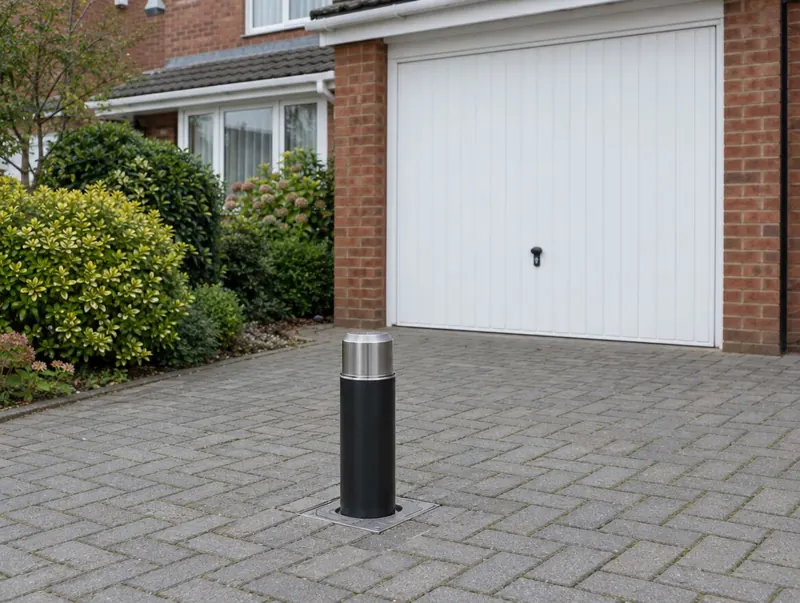 Computer-generated image
Gravesend telescopic bollards
Whether it's small industrial units, residential driveways and community car parks, telescopic bollards in Gravesend are planned around who needs to get through and who doesn't. Key-locked telescopic bollards that retract into a ground cassette, for driveways, private bays and access roads.
Coverage in Gravesend takes in the DA12, DA11 and DA13 postcode districts and nearby places like Shorne, Shorne Ridgeway, Sole Street and Gold Street. Jobs in Gravesend can be combined with work in Strood (5.7 miles), Dartford (6.8 miles), Rochester (6.9 miles) and Chatham (8 miles) (straight-line distances).
Gravesend at a glance
- Area
- Kent, England
- Highway authority
- Kent County Council (local roads)
- Planning authority
- the council for Gravesham
- Postcodes
- DA12, DA11 and DA13
- Guide price
- Typically £365–£1,245 per bollard + VAT (£435–£1,495 inc VAT for homes); minimum job £675
- Survey
- Free, with a fixed written quote
Guide prices for Gravesend
| Specification | Guide price | Includes |
|---|---|---|
| Standard | £365–£745 + VAT · £435–£885 inc VAT | Standard post, foundation, reinstatement |
| Upgraded | £635–£995 + VAT · £755–£1,195 inc VAT | Upgraded finish or fittings, reflective band, matched keys |
| Premium | £905–£1,245 + VAT · £1,095–£1,495 inc VAT | Heavy-duty or architectural spec, premium finish |
Per bollard with cassette, supplied and installed; +6% for South East. Guide only — the fixed price follows a survey.
Typical telescopic bollards jobs in Gravesend
Typical reasons Gravesend sites choose telescopic bollards:
- Domestic driveways where the bollard is used daily
- Sites with no power for automatic bollards
- Car parks where a removable post would go missing
What we check first in Gravesend
Kent County Council is the highway authority covering Gravesend's local roads. If any post would stand on adopted highway rather than your land, that consent is the first thing we sort out.
Bollards on private land often don't need planning permission, but it depends on the council's view, the height and the location; in a conservation area, next to a listed building or under an Article 4 direction, ask the local planning authority (the council for Gravesham) first — we flag this at survey.
Reinstatement matches the drive, whether block paving, tarmac, resin-bound or imprinted concrete. Drives commonly hide the water supply pipe, gas service, electric cable and drainage runs, often at shallow depth, and they cluster near the property boundary where posts are usually wanted.
- Confirm the bollard is on your land; bollards on a public footway or dropped kerb need the highway authority's agreement.
- Connect drainage only to surface water systems or a soakaway, never to a foul drain.
From survey to handover
Check depth and drainage
The free site survey checks how far down we can dig, where services run under the drive and how the ground drains. If water will stand, a drain connection is priced into the fixed written quote.
Form the drainage
A gravel soakaway is placed beneath the cassette, or a pipe is laid to a surface water drain or new soakaway.
Reinstate and test
The surface is made good to match. The post is raised, locked, lowered and locked several times to confirm smooth operation, and keys are handed over.
Options to consider
| Option | Detail |
|---|---|
| Lid and head designs | Flush hinged lids, removable caps or integrated heads that close the cassette top when lowered. |
| Diameter and height | Commonly around 90–140 mm diameter and 600–900 mm raised height, with larger posts for commercial use. |
| Lock types | Keyed cylinder locks, often with a cover to keep out dirt; keyed alike for multi-bay sites where one key should open every post. |
What affects the quote
When we price telescopic bollards in Gravesend, these make the biggest difference:
- Stainless or powder-coated finish
- Number of posts and keyed-alike locks
- Drainage: simple soakaway or a connection to a drain
After installation
Lubricate the lock with a suitable spray, especially before winter. If the post becomes stiff or will not lower fully, the usual causes are debris in the cassette or a blocked drain, both of which are easier to fix early than after the post has seized.
We can also service, repair or replace existing posts anywhere in Gravesend.
Common questions
Which parts of Gravesend do you cover for telescopic bollards?
We cover all of Gravesend (DA12, DA11 and DA13) and the rest of Kent. We also work in Strood, Dartford and Rochester.
Who gives permission for bollards on the pavement in Gravesend?
In Gravesend, work on adopted pavements and verges needs consent from Kent County Council, the local highway authority. Car parks, forecourts and other private land only need the owner's permission.
What's a typical price for telescopic bollards in Gravesend?
In Gravesend, typically £365–£1,245 per bollard with cassette, supplied and installed, plus VAT (£435–£1,495 including VAT for homeowners), with a minimum job of £675 plus VAT, using our South East guide prices. The fixed figure comes in writing after we've seen the site.
Is a telescopic bollard harder to lift than a removable one?
Usually easier, because you only lift it up a short distance within its cassette and many models have lift assistance. You also never carry it or store it anywhere.
How deep does a telescopic bollard go into the ground?
Usually around the exposed height of the post plus the cassette base and drainage layer, which often comes to a metre or more. The exact depth depends on the model. That depth is why we check for services under the drive first.