London · England
Timber bollard installation in City of London
Timber bollards supplied and fitted in City of London, London: surveyed, scanned for services, set in proper foundations and finished to match the ground.
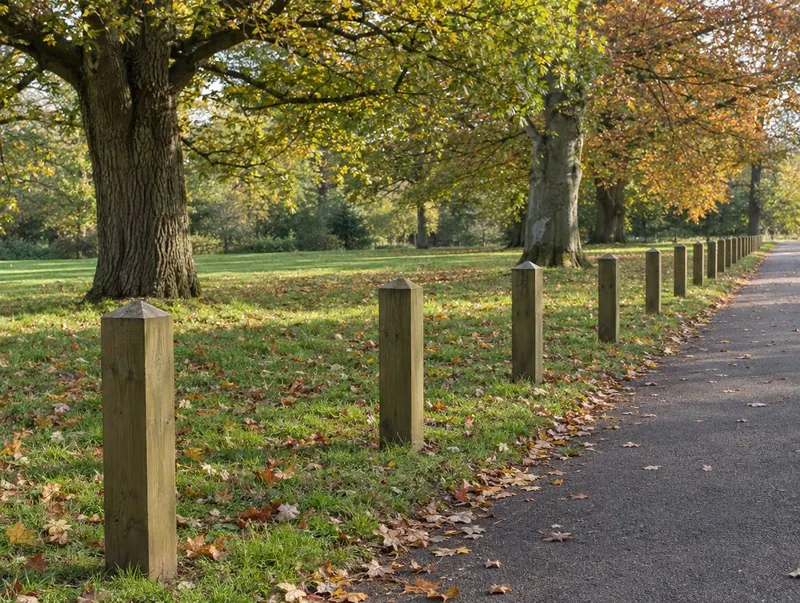 Computer-generated image
Timber bollards in City of London
We supply and fit timber bollards throughout City of London, typically for sites such as estate car parks, shopping parades and school gates. Timber bollards deter and guide vehicles; they are not tested barriers.
We cover the EC2V, EC2R, EC2Y, EC4N, EC4M and EC4V postcode districts in City of London. Jobs in City of London can be combined with work in Islington (2.2 miles), Tower Hamlets (2.5 miles), Westminster (2.6 miles) and Hackney (3 miles) (straight-line distances).
Local details
- Area
- London, England
- Highway authority
- the City of London Corporation (local roads)
- Planning authority
- The City of London Corporation
- Postcodes
- EC2V, EC2R, EC2Y, EC4N, EC4M, EC4V, EC2M and EC4R
- Guide price
- Typically £105–£395 per post + VAT (£125–£465 inc VAT for homes); minimum job £505
- Survey
- Free, with a fixed written quote
- Nearby
- Islington (2.2 mi), Tower Hamlets (2.5 mi), Westminster (2.6 mi), Hackney (3 mi)
Timber bollard prices in City of London
| Specification | Guide price | Includes |
|---|---|---|
| Standard | £105–£235 + VAT · £125–£275 inc VAT | Standard post, foundation, reinstatement |
| Upgraded | £195–£315 + VAT · £225–£375 inc VAT | Upgraded finish or fittings, reflective band, matched keys |
| Premium | £285–£395 + VAT · £335–£465 inc VAT | Heavy-duty or architectural spec, premium finish |
Per post, supplied and installed; +15% for London. Guide only — the fixed price follows a survey.
Typical timber bollards jobs in City of London
Common uses in a place like City of London:
- Verges on estates and rural lanes
- School frontages and nursery entrances
- Country parks, nature reserves and woodland car parks
Before we dig in City of London
the City of London Corporation is the highway authority covering City of London's local roads. Red routes are managed by Transport for London. If any post would stand on adopted highway rather than your land, that consent is the first thing we sort out.
Many private-land installations in City of London need no planning application, but the rules don't clearly cover bollards, so listed buildings, conservation areas and prominent frontages are worth raising with the planning team at The City of London Corporation before posts go in.
Turf around new posts is reinstated and, on sites used by mowers, posts are spaced so equipment can pass. Timber bollards usually go into soft landscape, so the ground varies more than with paved sites.
- Fit reflective bands or white tops where posts stand beside roads or in unlit car parks.
- Keep emergency vehicle access available, using a removable or hinged post where a route must open.
How the job runs
Set out the line
Posts are set out at spacings that stop cars passing between them while leaving gaps for walkers, buggies and wheelchairs.
Dig the holes
Holes are dug by hand or auger to the required depth, avoiding roots and checking for services along verges and footpaths.
Finish and tidy
Reflective bands are fitted, turf is reinstated around the posts and spoil is removed or spread as agreed.
Finishes and options
| Option | Detail |
|---|---|
| Reflective bands and studs | Reflective bands, white painted tops or inset studs so posts are visible on unlit sites. |
| Oak | Naturally durable heartwood that weathers to silver-grey. Suits parks, heritage settings and visible frontages. |
| Tropical hardwood | Very dense and long-lasting in ground contact. Specify certified sustainable sources. |
Pricing timber bollards in City of London
Two City of London jobs with the same number of posts can price quite differently. The usual reasons:
- Post size and length
- Fixing method: stone, concrete or steel shoe
- Species: treated softwood, oak or tropical hardwood
After installation
Timber naturally moves, checks and splits along its length as it dries; surface cracks in oak and hardwood are normal and rarely affect strength. Inspect posts at ground level, where rot starts, by probing for soft wood.
If posts in City of London are later hit or damaged, we can repair or replace them — see bollard repairs.
Timber bollards in City of London: FAQs
Which parts of City of London do you cover for timber bollards?
We cover all of City of London (EC2V, EC2R, EC2Y, EC4N, EC4M and EC4V) and the rest of London. We also work in Islington, Tower Hamlets and Westminster.
Who gives permission for bollards on the pavement in City of London?
In City of London, work on adopted pavements and verges needs consent from the City of London Corporation, the local highway authority. Red routes are managed by Transport for London. Car parks, forecourts and other private land only need the owner's permission.
What's a typical price for timber bollards in City of London?
In City of London, typically £105–£395 per post, supplied and installed, plus VAT (£125–£465 including VAT for homeowners), with a minimum job of £505 plus VAT, using our London guide prices. The fixed figure comes in writing after we've seen the site.
Is tropical hardwood a sustainable choice?
It can be, if it comes from certified sustainable sources. Ask for certification with the order. Oak and treated softwood from managed forests are alternatives.
Do timber bollards stop vehicles?
They stop most drivers deliberately mounting a verge and resist low-speed knocks, especially in dense hardwood. They are not tested barriers and should not be relied on against a vehicle driven at them deliberately.
Timber bollards in nearby towns
- Islington (2.2 mi)
- Tower Hamlets (2.5 mi)
- Westminster (2.6 mi)
- Hackney (3 mi)
- Camden (3.5 mi)
- Southwark (3.7 mi)